Midnight Morality: Why Your Inner Film Critic Goes Soft After 2 AM
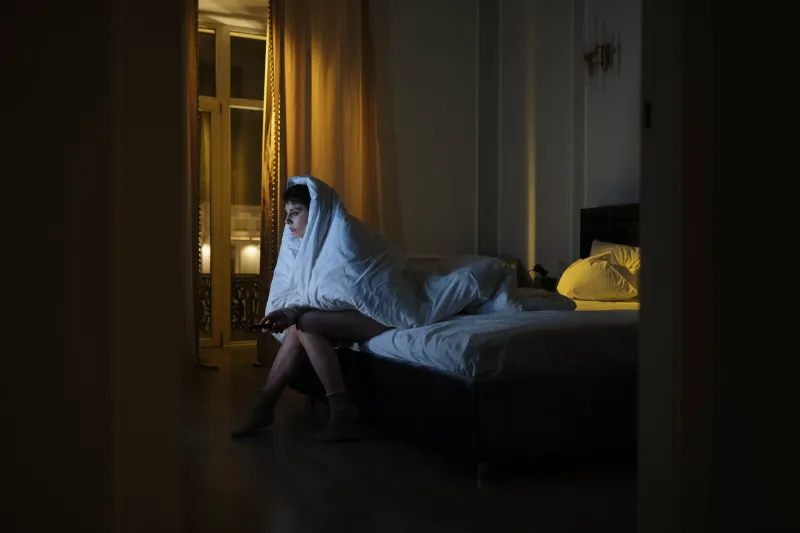
It's 2:17 AM. You've got a half-eaten bag of chips on your chest, the blue light of your TV is the only thing standing between you and total darkness, and you're watching a movie starring someone whose name, in any other context, would make you immediately change the subject. And yet — you're not changing it. You're into it. You're maybe even rooting for them.
Welcome to the Midnight Morality Dip. It's real, it's surprisingly common, and it says a lot more about human psychology than it does about your personal ethics.
The Tired Brain Is a Forgiving Brain
Here's the thing about late-night viewing that nobody really talks about: your prefrontal cortex — the part of your brain responsible for moral reasoning, critical thinking, and the internal voice that says wait, didn't this person do something terrible? — is basically clocking out around the same time you're pressing play on that fourth movie.
Sleep deprivation and late-night fatigue don't just make you sluggish. They selectively dial down the cognitive functions that require the most energy. Ethical evaluation is one of those functions. It's effortful work. Your brain does it constantly during the day, cross-referencing what you know about a person with how you feel about them in the moment. After midnight, that cross-referencing slows to a crawl.
What's left is the more instinctive, emotional part of your response — the part that just sees a charismatic performance, a compelling face, a story that's pulling you in. The critical apparatus hasn't disappeared, but it's operating at maybe 40% capacity. And 40% isn't enough to override a genuinely magnetic screen presence.
The Compartmentalization Effect
There's another layer to this beyond simple fatigue. Late-night viewing naturally creates what psychologists call psychological distance — a kind of emotional bubble that separates the experience you're having from your regular, daylight-hours identity.
Think about it: you're not watching a movie at 2 AM the same way you'd watch one at 7 PM on a Tuesday. The context is completely different. You're in a liminal space — not quite in your normal routine, not yet in sleep. The usual social accountability that governs your choices (what you'd recommend to a friend, what you'd mention at work, what you'd feel comfortable defending) is essentially offline.
In that bubble, a lot of the external noise around an actor's real-world reputation fades. You're not consuming a cultural product you'll have to contextualize for someone else tomorrow. You're just... watching. And that private, low-stakes context makes it much easier to engage with the work on its own terms, separate from everything you know about the person making it.
This is the same psychological mechanism that explains why people will laugh at a joke late at night that they'd find genuinely offensive at a dinner party. The audience effect — the awareness of being judged — is removed.
Hollywood's Complicated Legacy, Amplified
This phenomenon hits differently when you consider just how many major films are entangled with complicated figures. American cinema's catalog is enormous, and a substantial chunk of it features actors, directors, or producers whose names now carry significant baggage. Woody Allen's films. Roman Polanski's work. The long shadow of the #MeToo reckoning across decades of Hollywood output.
During the day, navigating those titles feels like a whole thing. There's the internal negotiation — can I separate the art from the artist? — followed by the external one: what does it say about me if I'm watching this? Those questions are legitimate, and they're worth asking.
But at 2 AM, alone, with no one watching, the calculus shifts. The questions don't disappear entirely, but they lose their urgency. You're not making a public statement by pressing play. You're just exhausted and curious and a little bit lost in the story. The art-versus-artist debate, which can feel like a genuine moral crisis in daylight, becomes something more like background noise.
That's not necessarily a failure of character. It might just be a natural human response to the conditions of late-night solitude.
Does It Actually Matter?
Here's where it gets genuinely interesting: does the midnight forgiveness effect change anything in the long run?
Most people who find themselves warming to a controversial figure during a late-night viewing session don't wake up the next morning having fundamentally revised their opinions. The prefrontal cortex comes back online. The critical distance closes. The discomfort returns.
What late-night viewing might actually be doing is giving people a low-pressure space to engage with complexity they'd otherwise avoid entirely. A lot of the most culturally significant films in American cinema come attached to deeply problematic people. Refusing to ever engage with that work is one valid choice. But so is engaging with it thoughtfully, on your own terms, in a context where you're not performing your ethics for an audience.
The 2 AM screening is, in a weird way, one of the more honest modes of film consumption. You're not watching to signal anything to anyone. You're watching because something in you wants to.
The City That Never Judges After Midnight
There's something very New York about this whole dynamic, actually. This city has always had a complicated relationship with its night owls — the people who do their most honest living after the sun goes down, when the performance of daily identity gets a little looser.
Cinema at midnight operates the same way. The lights are out. The social contract is suspended. You're allowed to be a little more honest about what you find compelling, what holds your attention, what makes you feel something — even when the source of that feeling comes wrapped in moral complexity.
Is it a perfect system? Obviously not. Awareness matters. Context matters. The conversations we have in daylight about who gets to make art and who gets protected by industry power are important and necessary.
But the fact that your brain softens its grip on those conversations after midnight isn't a bug in your character. It's a feature of being human — tired, curious, and genuinely unable to resist a good story, even when the story comes with strings attached.
So the next time you catch yourself three movies deep at 2 AM, watching someone you'd never defend at brunch, maybe don't be too hard on yourself. Your brain isn't broken. It's just running on night mode.